Contractor and Distributor Relationships: The Hidden Complexity in Building Materials CRM
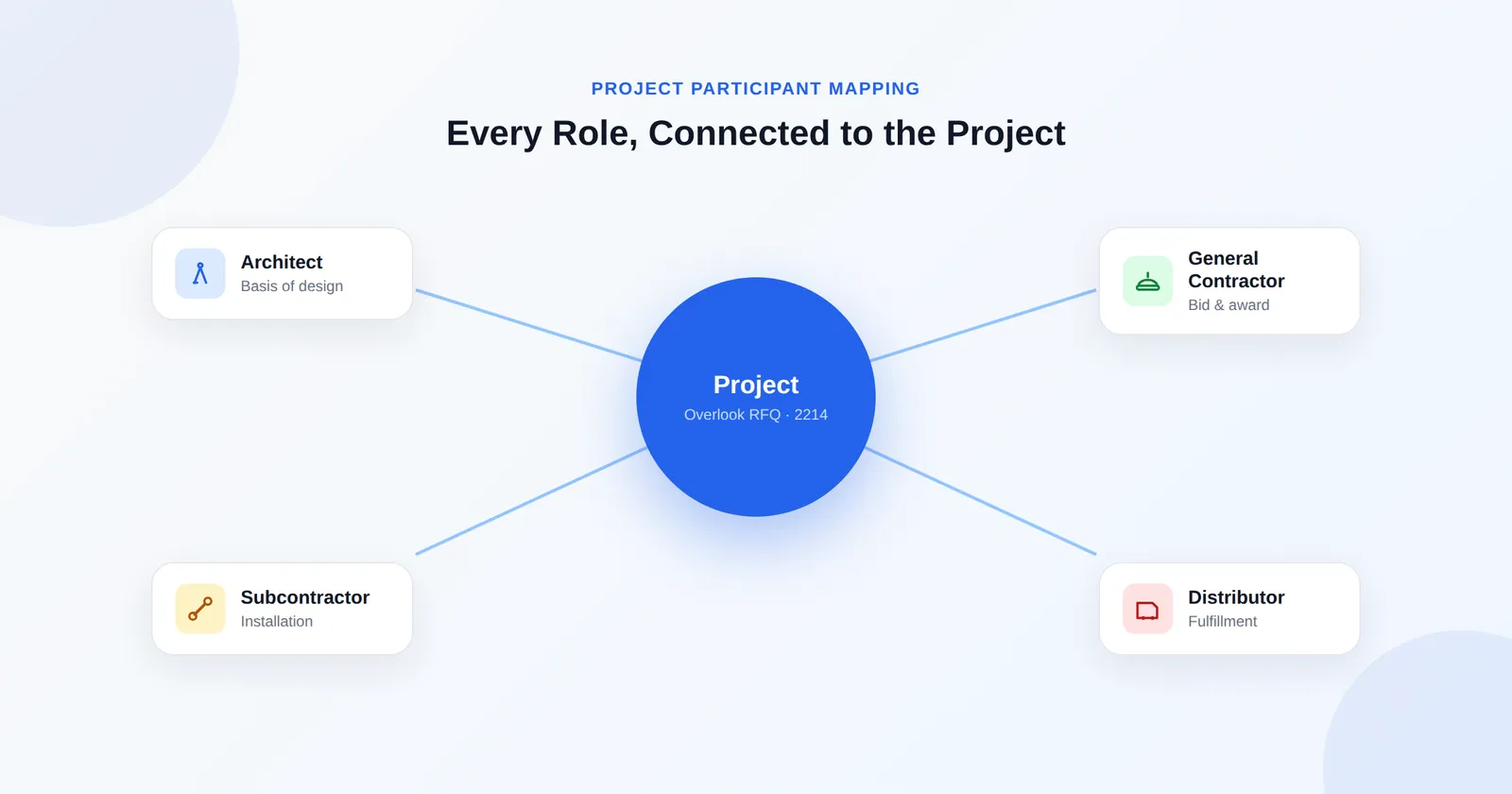
A single building materials project can involve an architect, a general contractor, several subcontractors, and two or three distributors, each playing a different role, at a different point in the timeline, with different incentives. Most CRMs model all of them one way, as a generic "Contact" linked to an "Account." That is a filing cabinet, not a data model.
Four roles, four different questions
Each participant type matters to your sales strategy for a different reason:
- Architects decide the basis of design. The question: are we specified, and are we at risk of substitution?
- General contractors decide who gets the order. The question: do they trust our product, and have we made their bid process easy?
- Subcontractors install the product. The question: are there installation issues that could affect the relationship or create warranty risk?
- Distributors fulfill and often influence substitutions at the point of sale. The question: are they loyal to our product, or steering volume to a competitor?
A flat contact list answers none of these questions. It gives you an email address.
Why project-level mapping changes the picture
When every participant is linked to the specific project they're involved in, not just to your company in the abstract, you see patterns that otherwise stay hidden:
- A distributor who wins your product on some projects and a competitor's on others, revealing where loyalty is soft
- A general contractor who consistently sources from a specific distributor, suggesting where to focus relationship-building
- A subcontractor whose projects have a higher-than-average substitution rate, worth investigating before it becomes a pattern
A generic contact database disconnected from project context shows none of this.
The practical takeaway
Modeling participants as project-linked roles, not people in an address book, shows where your influence is strong, where it's weak, and where a competitor is winning.
Want to see this in your own pipeline?
Talk to our team about how Baucore maps your projects, specifications, and participants inside Salesforce.