Project Research in 2026: The Seven Questions Behind Every Won Spec
A rep hears a project name in a meeting. A 240-bed hospital expansion, two counties over, mentioned in passing by a distributor. It goes into a notebook. Maybe, that evening, it goes into the CRM as a name, a city, and a date. Three months later the project comes back as an RFQ from a mechanical contractor nobody has quoted, and the answer to "what do we know about this one?" is the name, the city, and a date that is now wrong.
Project research in building materials takes hours that few reps have.
What research has to answer
A usable project record answers seven questions, and a name in a CRM answers none of them:
- Is this project real? Announced, funded, permitted, and about to break ground are four very different things, and only one of them justifies a site visit.
- Where is it in its lifecycle? Schematic design, design development, bid, buyout, construction. The window to influence the spec closes long before the window to sell the material.
- Who owns it? Developer, institutional owner, public agency: each buys differently and tolerates value engineering differently.
- Who is writing the spec? The architect of record, the MEP or facade consultant, the specifier who will decide whether your product name or a performance description ends up in Division 08.
- Who is bidding it? The GC shortlist, and behind it the subs who will actually price your material and propose the substitution.
- What is our position? Basis-of-design, listed as an approved equal, or nowhere, and whether that changed last month without anyone telling you.
- When is the buying window? The gap between "the spec is locked" and "the submittal is approved" is where specs are lost.
Multiply seven questions by an active portfolio of 80 to 150 projects per rep, and you see why most CRM project records in this industry are half-empty.
Why the manual research pass fails
The manual pass is correct but unrepeatable. A thorough rep will check the county permit portal, search the local business journal, look up the architect's project page, pull the owner's board minutes if it is a public project, and check LinkedIn to see whether the project manager they knew is still at the same firm. Done well, that is thirty to sixty minutes per project.
Three things then go wrong:
It happens once. The research pass is done at intake, when the project is least knowable, and never repeated. Permits get issued, ownership changes hands, the GC gets awarded, the specifier moves firms, and none of it reaches the record.
It never leaves the rep's head. The rep's findings stay in a notebook, an email thread, or a memory. The CRM shows a name and a stage that was accurate one quarter ago, so pipeline reviews run on rep perception instead of project facts.
It is the first thing cut. When quoting volume spikes, reps skip research, just as the project count rises and the need peaks.
Why this year raises the stakes
Two trends are converging in the US market. Projects spend longer in preconstruction while owners revisit budgets, and bid lists have grown longer even as backlogs stay solid [1]. Longer preconstruction means more time for your spec position to erode without a single visible event. Longer bid lists mean more parties touching the project, each of whom can introduce a substitution.
No capacity is coming to absorb the extra research. The industry needs an estimated 349,000 net new workers in 2026 just to hold labor supply and demand in balance, rising to 456,000 in 2027, with retirement driving most of that demand [2]. Few companies are staffing up a project research desk. Automate the research or skip it.
The pipeline of projects worth researching is not shrinking. Data center construction alone had over $400 billion in future projects published in 2025, with late-stage preconstruction work carrying billions in planned starts into 2026 [3].
What the Project Agent does with those seven questions
Baucore's Project Agent runs the research pass continuously instead of once.
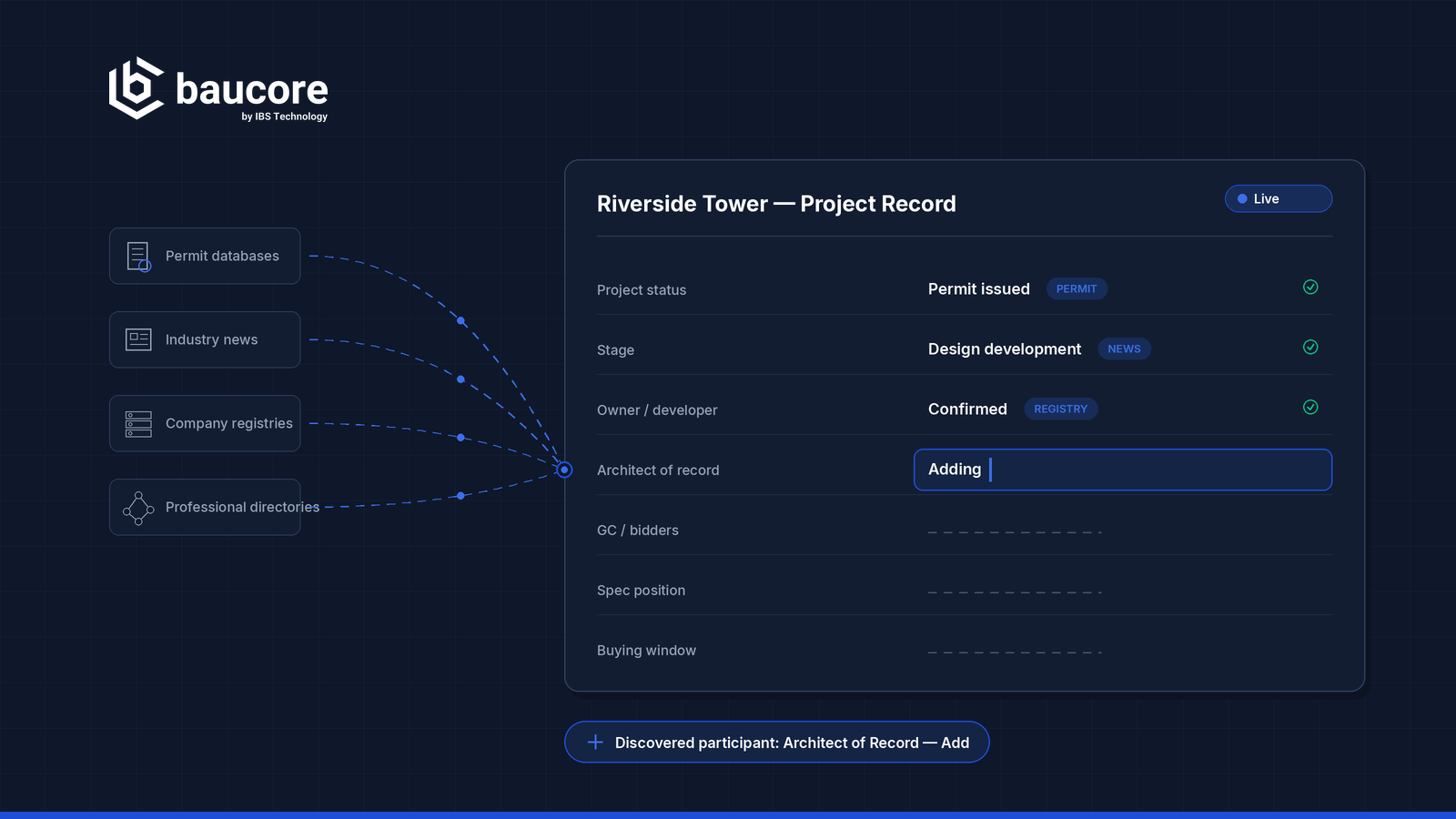
It monitors public sources against your active projects (permit databases, news feeds, company registries, professional directories, industry announcements) and matches what it finds to the right project record instead of dumping it into a feed. A permit approval on a project you flagged eight months ago surfaces as a notification on that project, to the rep who owns it.
Where the finding maps to a field, it updates the field: stage, timeline, product specification, contact details. You configure this: fully autonomous, or a single confirmation before it writes. Where the finding is a person or a company you did not have (the architect of record, a newly awarded GC, a consultant added to the design team), the agent presents it as a discovered participant, with the role, that you add with one tap, so your Beteiligte structure grows as the project team grows.
Underneath, it watches the things that predict a lost spec: specification status, stakeholder engagement, competitive risk, timeline alignment, stage progression. Each morning it delivers a prioritized action list per rep instead of a research task list, built from internal CRM signals and external intelligence together.
The seven questions stay answered instead of going stale.
What it costs to leave the questions unanswered
Revenue leaks out of the pipeline when information never reaches the CRM, not when reps sell badly. The spec position that was quietly swapped in a design revision. The project that stalled for five months while it sat in the forecast at 60%. The submittal that went out with a competitor's product because nobody knew the mechanical sub had been awarded. The architect who moved firms and took three future projects along, to a competitor who found out.
None of these appear as a lost deal. They appear as a forecast that never converts and a pipeline review where nobody can explain why.
See what it finds on one of your projects
Judge a research pass by running it on a project you know well. Enter a project name and a location on the Project Agent page and watch the agent run a live research pass, the same one it runs continuously against every project in your CRM.
References
Want to see this in your own pipeline?
Talk to our team about how Baucore maps your projects, specifications, and participants inside Salesforce.