Why Specification Tracking Makes or Breaks Building Materials Sales
Ask any building materials sales rep what actually decides a project, and most won't say "the bid." They'll say "the spec." By the time a project reaches the bidding phase, the real work of getting a product listed as the basis of design has usually already happened — or already been lost.
Specification is a phase, not an event
Generic CRMs model sales as a funnel: lead, opportunity, quote, close. That works for transactional sales, but building materials projects run on a different clock. A single project can spend months or years moving through design development, value engineering, and substitution review before a single quote is ever requested. If your CRM only starts paying attention once an RFQ lands in the inbox, you're joining the story after the plot has already been decided.
What "specified" actually means
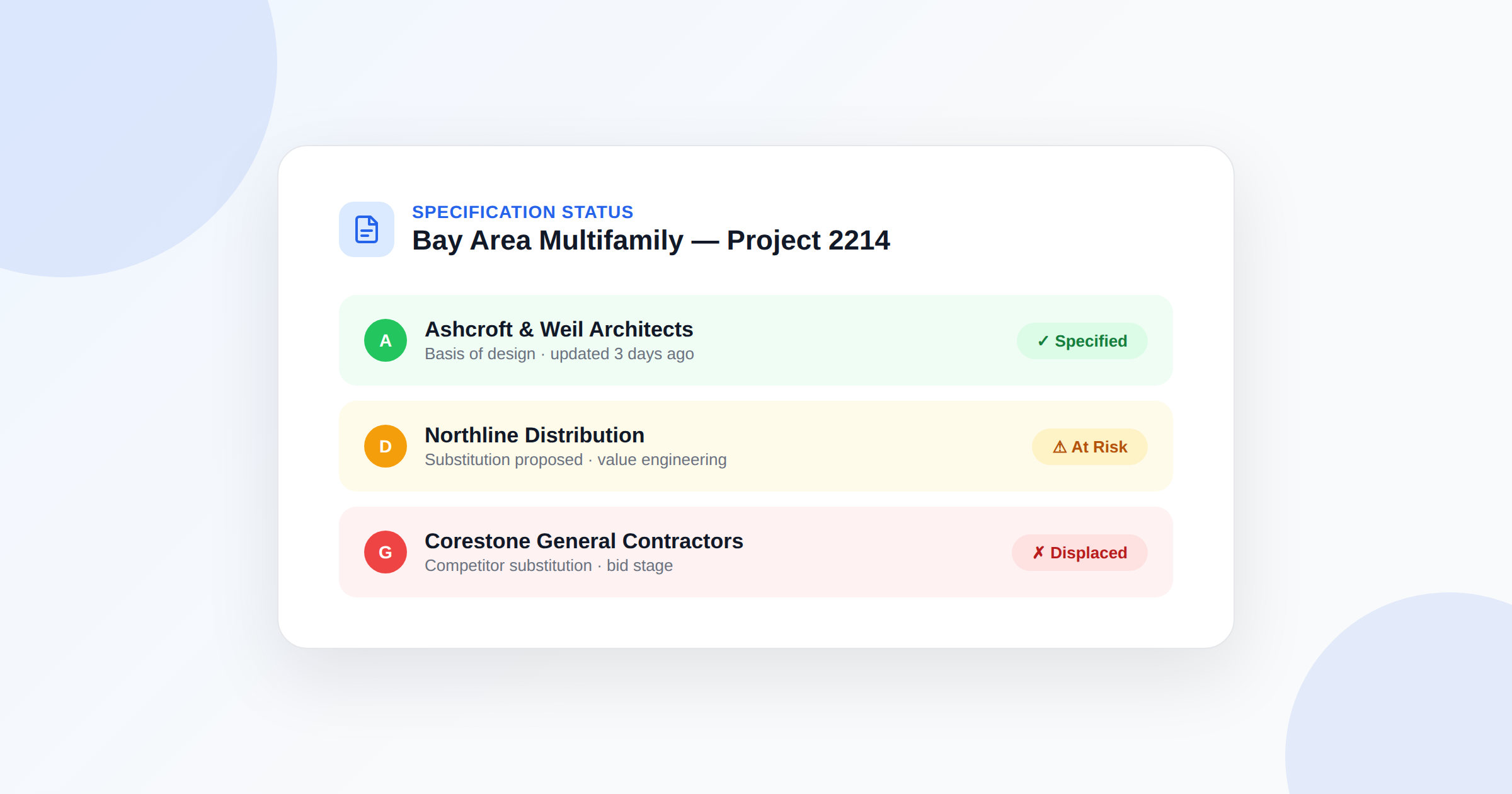
Being specified isn't a status field you set once. It's a state that can change without anyone telling you:
- A distributor swaps in a competitor's SKU during value engineering
- An architect updates the basis-of-design language after a client request
- A general contractor proposes a substitution to hit a tighter budget
Without a system that tracks specification status per project, per participant, and per revision, these changes are invisible until a lost bid explains them after the fact.
What good specification tracking looks like
A specification tracking system worth using should let a rep answer three questions about any active project in seconds:
- Are we currently specified, at risk, or already displaced?
- Who changed that status, and when?
- What's the substitution risk on this project relative to similar ones we've won or lost?
That means specification status needs to be a first-class, timestamped record tied to the project — not a comment in an opportunity, and not tribal knowledge held by one account manager who might leave.
The payoff
Teams that track specification status systematically catch substitution risk while there's still time to act — a call to the architect, a revised submittal, a distributor conversation — instead of finding out during the bid tabulation. That's the entire difference between a proactive sales motion and a reactive one.
Frequently Asked Questions
What does it mean for a product to be "specified" in building materials sales?
Being specified means your product is named as the basis of design in project documents — the default product a contractor will bid unless a substitution is approved. It is the single highest-leverage position in a project sales cycle.
Why do generic CRMs struggle with specification tracking?
Generic CRMs model sales as accounts and opportunities, not projects with a long-running specification phase. Without a project-level record that tracks specification status over time, substitution risk and specification changes go unnoticed until a bid is lost.
How often should specification status be reviewed on an active project?
Specification status should be reviewed whenever a project reaches a new phase — design development, value engineering, permitting — since each phase is a common point where substitutions get introduced.
Want to see this in your own pipeline?
Talk to our team about how Baucore maps your projects, specifications, and participants inside Salesforce.