The $30,000 EDI Question: Why Most GCs and Distributors Still Order by Email
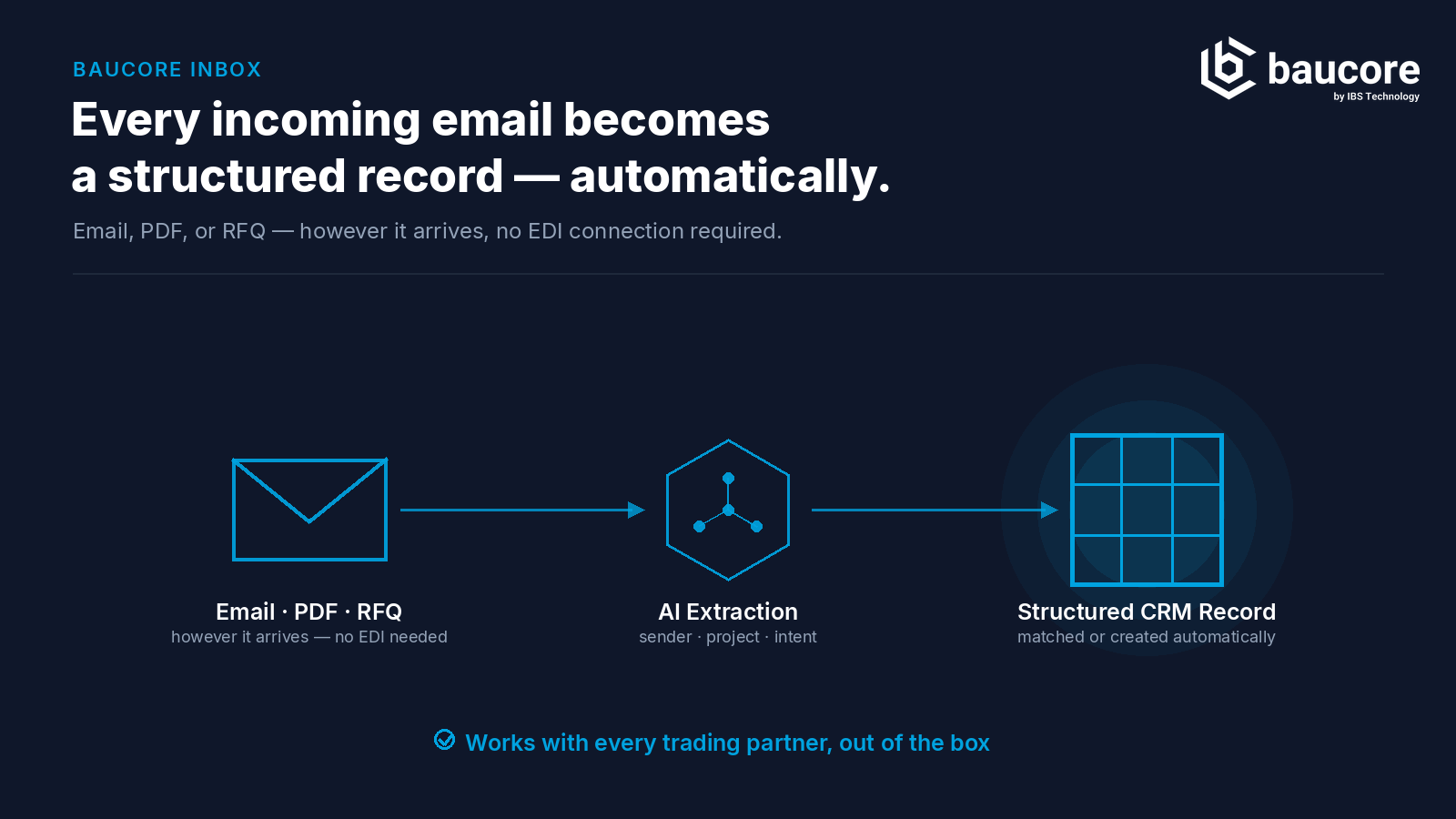
It's 4:47 on a Friday when the PO shows up. A project manager at a general contractor forwards a PDF, quantities and item numbers laid out in a table that doesn't match anything the ERP expects. Someone on the order desk opens it, reads it line by line, and retypes it by hand so the order can be confirmed before the weekend. Multiply that by every GC, subcontractor, and regional distributor a manufacturer sells through, and the order desk isn't processing orders — it's transcribing them, one inbox at a time.
The obvious fix, on paper, is EDI. Electronic data interchange has been the backbone of B2B order processing for decades, and for good reason: a properly connected trading partner exchanges purchase orders, invoices, and shipping notices as structured data, with no human retyping anything. The problem for building materials manufacturers isn't that EDI doesn't work. It's that almost none of their actual trading partners are set up to use it.
EDI compliance is a big-box mandate, not an industry norm
EDI adoption in construction supply didn't spread organically from the bottom up — it was pushed down from the top by a handful of major retailers. Home Depot and Lowe's require EDI compliance from the suppliers who sell through their channels, and that requirement is real leverage: get on EDI, or lose the shelf space. But that dynamic only touches the narrow slice of a manufacturer's business that runs through big-box retail. The rest of the trading partner base — the GC bidding a single job, the regional distributor carrying a dozen manufacturer lines, the architect's office forwarding a spec change, the subcontractor confirming a substitution — was never part of that mandate, and never will be. These relationships are exactly the ones that make up most of a building materials sales cycle, and exactly the ones that keep transacting by email.
Why "just get everyone on EDI" doesn't work here
Legacy EDI is priced for the relationship Home Depot has with its suppliers: high volume, long duration, worth the investment to eliminate friction permanently. Setting up a single new trading partner connection on a legacy EDI system commonly costs $1,000 to $5,000 in onboarding fees alone, and a first-year implementation across a handful of partners often lands between $30,000 and $100,000 once software, mapping, and per-transaction charges are added up [1]. That math works when the partner relationship is stable and the volume is predictable. It falls apart the moment the "partner" is a GC who orders from you once for one job, or a distributor who adds and drops manufacturer lines project by project. Building materials trading relationships shift constantly — a basis-of-design swap during value engineering, a new subcontractor added mid-project, a distributor splitting volume between two manufacturers on the same bid — and none of that churn is compatible with paying five figures to wire up a fixed data pipe to any single partner. For the overwhelming majority of a manufacturer's or distributor's order volume, EDI was never going to be the answer. Email already is the protocol everyone uses; the gap is what happens to that email once it lands.
What Baucore Inbox actually does with the email you're already getting
Baucore Inbox doesn't ask a GC or distributor to change anything about how they send a PO or RFQ, or an architect's office to change how it sends a spec update. Every incoming email — sent to a dedicated Baucore-generated address, or captured directly through the Outlook add-in — is read automatically. Extraction runs against the sender, the participants named in the body or signature, the project it relates to, and the intent of the message itself: is this an order, a quote request, a spec change, a new contact introducing themselves. That extracted data is then matched against existing Salesforce records — the right project, the right account, the right contact — or used to create new ones when nothing matches yet. Intent-based flow mapping takes it from there, routing an order differently than a spec inquiry differently than a new-lead email, without a rep having to sort the inbox by hand. An activity dashboard shows the extraction status for every message that comes through, and any email the AI couldn't confidently parse gets flagged for a quick manual check rather than silently dropped. The mechanism is the important part: Baucore Inbox isn't a smarter EDI connector. It's built on the assumption that the email itself, in whatever format it already arrives, is the input — no trading partner integration required.
This is also where the cost comparison actually lands in the manufacturer's favor. The $30,000-to-$100,000 legacy EDI number cited above is the cost of formalizing a data pipe with one partner at a time [1]. Baucore Inbox instead treats every partner's email the same way, structuring whatever arrives without a per-partner setup cost at all — which matters enormously in a channel where most trading partners will never generate enough volume to justify a dedicated EDI connection in the first place.
The data-quality cost of leaving it manual
The stakes here aren't just about avoiding EDI fees — they're about what manual re-keying is already costing on the data side. Poor data quality and miscommunication account for 52% of rework across construction projects, and bad data is estimated to cost the global construction industry $1.85 trillion annually [2]. A PO that gets retyped by hand from a PDF is a data-entry event with every opportunity for that kind of error: a transposed quantity, a missed line item, a unit price copied from the wrong column. Every one of those small mistakes is also a project that, once it's finally logged, never gets linked back to the account history that would show a sales rep why this customer specified the manufacturer's product in the first place — the exact kind of visibility Baucore's project-intelligence tools are built to surface once the data is actually in the system.
What it costs to keep waiting
Treating "email versus EDI" as a trading-partner-by-trading-partner integration problem means the order desk stays the bottleneck indefinitely — because the partners worth wiring up on EDI were never the ones creating the backlog. Every order that sits in someone's inbox until it's manually keyed is a delay the GC notices, a line item that might get miscounted, and a project relationship that never makes it into the CRM where it could inform the next recommendation, the next follow-up, or the next quote. The manufacturers and distributors who keep waiting for their trading partners to "get on EDI" are waiting for a shift that, for most of their partner base, was never going to happen. The email was never the problem. What happened to it after it arrived was.
References
Want to see this in your own pipeline?
Talk to our team about how Baucore maps your projects, specifications, and participants inside Salesforce.